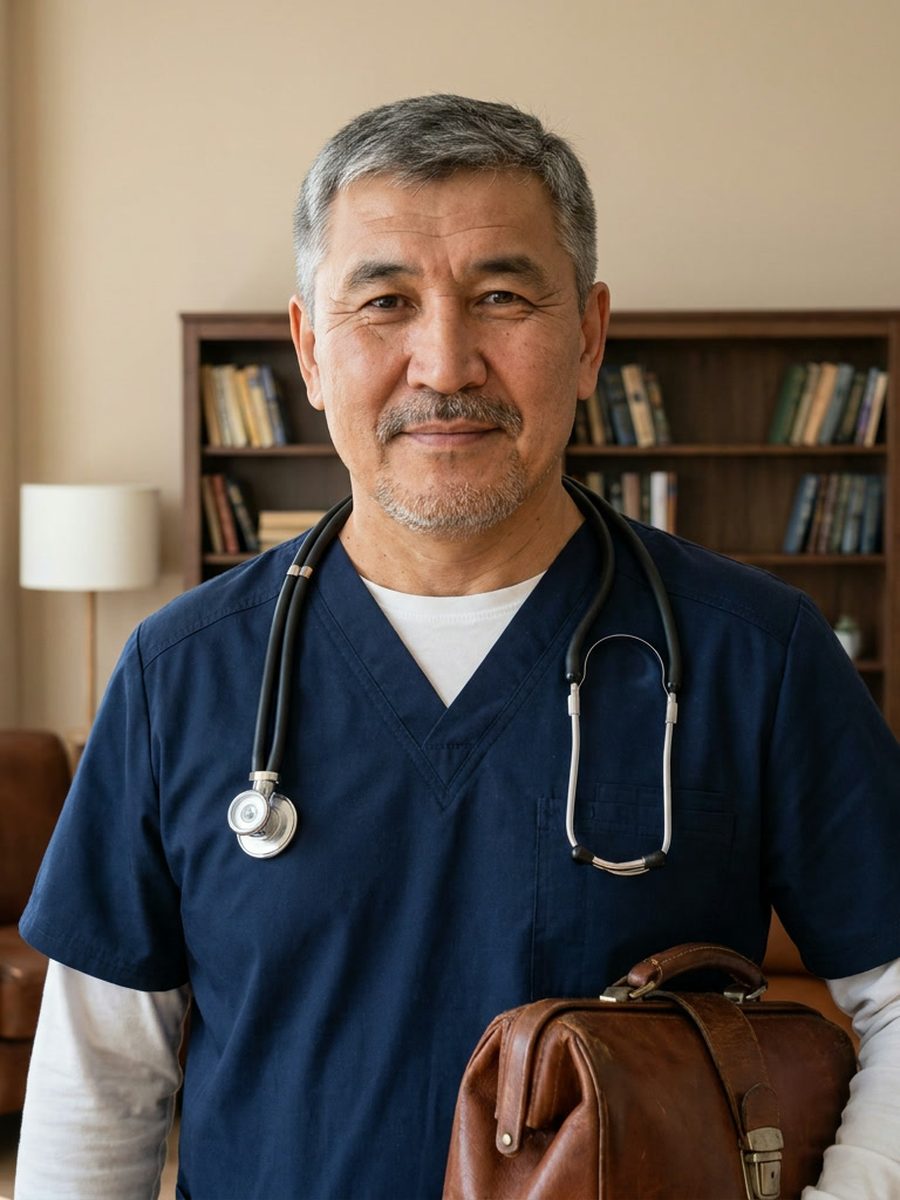

Reviewed byAndrey Vetrov, MDPsychiatrist · updated 11.11.2026
Key facts
- Who carries it out
- a psychiatrist with experience in both outpatient and inpatient care; when needed, together with an addiction physician or a neurologist
- Format
- an in-person home visit anywhere in Almaty and its suburbs: Kaskelen, Talgar, Boralday, Otegen Batyr, and the dacha (country-house) communities in the foothills
- Duration
- 60–90 minutes for the first assessment; travel time depends on the district and traffic, and we give an estimate when you call
- Confidentiality
- medical confidentiality under the Code of the Republic of Kazakhstan “On Public Health and the Healthcare System,” an unmarked car, and no entry in the psychiatric registry
- When it is urgent
- suicidal thoughts, acute psychosis, threatening aggression, or confusion: call 103 or 112 immediately
- Outcome
- an assessment of the person's condition, a provisional diagnosis, a treatment prescription, and a follow-up plan or a referral for inpatient care
What to know
Most calls come not from patients themselves but from their relatives. A mother in Bostandyk district has not got out of bed for three weeks; a father stopped recognizing his grandchildren after a stroke; an adult son who works in IT has not left his apartment in Almaly district for a month and barely speaks. Driving someone like that across half the city through rush-hour traffic on Al-Farabi or Sain avenues usually ends in a refusal or a family row. So the psychiatrist comes to them: people feel calmer in familiar surroundings, and the doctor sees their real living conditions, daily routine, and the medications on the shelf.
A psychiatrist is a medical doctor, not a psychologist: they carry out a psychiatric examination, make a diagnosis according to ICD-10 criteria, prescribe medication, and decide whether hospital admission is needed. A home visit does not replace inpatient care and is not an emergency service. If a person talks about suicide, hears threatening voices, behaves aggressively and dangerously, or does not recognize loved ones after a sudden deterioration, call 103 or 112 rather than waiting for a scheduled visit. In all other cases, a home appointment is a calm and complete way to start treatment.
When to Call a Psychiatrist to Your Home
- the person refuses to leave the house but agrees to talk to a doctor at home
- an elderly relative has become confused, forgetful, or anxious in the evenings
- severe depression: not getting up, not eating, not looking after themselves for several weeks
- a relapse in someone with a known diagnosis who has stopped taking their medication
- severe anxiety or panic attacks make it impossible to get to a clinic
- after discharge from a hospital, the treatment needs to be checked
- the family does not understand what is happening and needs a doctor's view on the spot
If life is at risk — loss of consciousness, seizures, hallucinations, overdose, suicidal thoughts — call 103 or 112. Helpline for children and young people: 150.
Why Families in Almaty Often Choose a Psychiatrist Home Visit
The city is large and spread out: at rush hour it can take more than an hour to get from Nauryzbay district to Turksib, and even longer from Kaskelen or Talgar. For someone with severe depression, panic disorder, or dementia, the journey itself becomes an obstacle. Many elderly patients live in private houses near the foothills or stay at their dachas all year round, and their relatives physically cannot bring them in. A home visit removes this problem.
The second reason is fear of exposure. Even in a big city where most people are strangers, patients still worry that colleagues or neighbors will see them outside a psychiatrist's office. Students fear trouble at university, professionals fear trouble at work. A home visit is made without any identifying signs, and the doctor arrives like an ordinary guest. The third reason is the nature of the disorders themselves: with marked apathy, paranoid experiences, or social anxiety, a person is far more likely to see a doctor at home than to go to one.
How a Psychiatrist Home Visit Works
It starts with a short phone or video call with a relative: the coordinator and the doctor clarify what is happening, whether there is any danger, what medications the person takes, and whether there has been a diagnosis before. We will ask you to prepare discharge summaries and a list of medications. The doctor then arrives and meets the patient, talks with them privately and separately with the family, and assesses mood, thinking, memory, sleep, and the risk of self-harm. At the end, the doctor explains what is going on, gives prescriptions, and sets out a plan: when the next visit or online check-in will take place.
Help cannot be provided safely at home in cases of acute psychosis with aggression, active suicidal intent, confusion, intoxication, or a sudden deterioration in an elderly person with a suspected stroke. These situations require 103 or 112 and hospital care. If the patient objects to the visit, the doctor will not enter by force: involuntary psychiatric examination and admission are possible only on the grounds and in the manner set out in the law of the Republic of Kazakhstan, and by a court decision.
How we help
Psychiatric assessment
The doctor conducts a clinical interview and assesses appearance, speech, emotions, thinking, perception, memory, and the person's insight into their condition. When needed, standardized scales for depression, anxiety, or cognitive impairment are used. The doctor always asks about physical illnesses and medications, because in older people many psychiatric symptoms are linked to blood pressure, the thyroid gland, or side effects of medication.
Prescribing treatment
If medication is needed, the psychiatrist chooses it taking into account age, coexisting conditions, and whatever the person already takes. This may include antidepressants, antipsychotics, mood stabilizers, or anxiolytics — only as prescribed by the doctor, with no self-adjustment of doses. Relatives are told how to give the medication, which side effects to expect, and when to call the doctor.
Family consultation
Often the most valuable part of the visit is the conversation with loved ones. The doctor explains what is happening to the person, how to talk to them, what not to do, and how to recognize a deterioration. For families caring for an elderly person with dementia, this covers home safety, daily routine, and nighttime restlessness. For families of a teenager or student, it covers how to offer support without pressure and control.
Ongoing follow-up
Treatment continues after the first visit: a repeat home visit in one to two weeks, online check-ins, or an in-person appointment at the clinic once the person is ready for it. If it becomes clear that home care is not enough, the doctor helps arrange a referral to a Akalam inpatient unit or to the state psychiatric service and explains how to prepare for admission.
How treatment works
- 01Call or WhatsAppThe administrator and the doctor on duty clarify the situation and tell you what to do right now.
- 02Examination or consultationThe doctor visits your home, sees you at the clinic or joins by video.
- 03Treatment planWe choose the format — at home, inpatient, psychotherapy or rehab — with a clear price.
- 04Ongoing supportYour doctor and psychotherapist stay in touch: follow-ups, family support and relapse prevention.
Myths and facts
MythIf you call a psychiatrist, the person will immediately be put on the registry
FactPaid anonymous care does not involve registration with the state psychoneurological dispensary (PND). Information about the visit is protected by medical confidentiality under the Code of the Republic of Kazakhstan “On Public Health and the Healthcare System” and is disclosed only in cases expressly provided for by law. Employers, universities, and neighbors will not find out about the visit.
MythThe psychiatrist will come and take the person to a hospital
FactThe psychiatrist comes to examine and help. Hospital admission happens only with the patient's consent, and involuntary admission only by a court decision in the manner established by law. Most often, after the visit, the person is treated at home.
MythAn assessment at home will be incomplete
FactFor most conditions, the interview and observation are the main methods of psychiatry, and they can be carried out fully at home. If blood tests, an EEG, or an MRI are needed, the doctor will provide referrals. There is only one limitation: acute and dangerous conditions require a hospital.
Prices: Psychiatrist home visit
| Psychiatrist home visit | 35 000 ₸ |
| Psychiatrist consultation at the clinic | 15 990 ₸ |
| Psychiatrist home visit | 35 000 ₸ |
| Follow-up visit, treatment adjustment | 12 000 ₸ |
| Phone consultation | free |
Prices are approximate: the doctor confirms the exact cost after the examination, before treatment starts.
Confidential
We do not register patients with state dispensaries or share information with employers. You do not have to give your surname; doctors arrive in unmarked cars. Medical confidentiality is protected by the Code of Kazakhstan “On Public Health and the Healthcare System”.
Clinic addresses
FAQ
How quickly can a psychiatrist get to me in Almaty?
It depends on the district and the time of day. Within the central districts at quiet times it is usually faster; at rush hour or during snowfall it takes longer, and trips to Kaskelen, Talgar, or the foothill dachas depend on the highway. The coordinator will give you the exact time when you call. If waiting is dangerous, do not wait — call 103.
Can I call a doctor if the person is against it?
The doctor can come and talk with the family, and with the patient if they at least agree to come out and talk. An adult cannot be examined by force. If there is a threat to their life or to others, call 103 or 112: decisions about involuntary care are made only in accordance with the law of the Republic of Kazakhstan.
What should we prepare before the psychiatrist arrives?
A list of all medications the person takes, including sleeping pills and blood pressure medication; hospital discharge summaries and previous reports from a psychiatrist or neurologist; and recent test results, if you have any. It helps to write down in advance when the changes began and what exactly worries you. Ideally, the home should be calm, with a place to talk privately.
Do you visit elderly people with dementia?
Yes, this is one of the most common reasons for a call. The doctor will assess memory and behavior, check whether a physical illness is behind the deterioration, adjust medications, and explain to relatives how to organize care. Dementia management is covered in more detail on a separate page; what matters here is that the first assessment can be done at home.
Can I call a psychiatrist at night or on the weekend?
Yes, Akalam takes calls around the clock, but it is better to schedule a planned visit for a convenient time when all family members are at home. Night calls usually come when there is a sudden deterioration: if there is a threat to life, delusions with aggression, or confusion, call 103 or 112 first, not a paid home visit.
How is a home visit different from a consultation at the clinic?
In terms of the examination itself, there is almost no difference. The difference is that the doctor sees the home environment, and the patient does not have to travel. At the clinic, it is easier to carry out additional tests right away and to meet a psychotherapist. If the person can get to the clinic, an in-person appointment is often more convenient; if not, a home visit is the answer.
Sources and review
Prepared by the Akalam medical editorial team based on:
- ICD-10 and ICD-11: mental and behavioural disorders
- Clinical protocols of the Ministry of Health of Kazakhstan
- Code of Kazakhstan “On Public Health and the Healthcare System”
- WHO: mental health and substance use
- NICE and APA clinical guidelines
This information is for reference and does not replace a doctor's consultation. Editorial policy